
The email arrives in a lot of inboxes that belong to people with celiac disease: a supplement newsletter, a peptide forum digest, a friend forwarding a link with “have you seen this?” typed above it. The pitch is always some version of the same sentence: a peptide, clinically studied, designed to seal the gut lining that gluten pries open. For someone who has spent a decade reading ingredient labels in grocery store aisles, hunting for hidden wheat starch, the idea of a pill that could patch the barrier itself sounds less like marketing and more like relief.
That peptide is larazotide, and its story is more interesting, and more cautionary, than either the sales copy or the skeptics usually let on. It is not a scam compound cooked up for internet wellness culture. It is a real drug candidate that ran the actual gauntlet, mechanism studies, dose-ranging trials, a Phase 3 program, the works. What makes it worth understanding is exactly how that gauntlet ended, and why the ending matters more than the promising beginning.
A barrier with a switch, and a drug built to flip it back
Picture the lining of the small intestine as a single layer of tiles, cemented together at the seams by structures called tight junctions. Those seams are not fixed; they are more like adjustable seals, opening and closing to control what passes from the gut into the bloodstream. The body has a known lever for that seal, a protein called zonulin, and when zonulin signaling ramps up, the seams loosen, a state that shows up in popular writing as “leaky gut.” A frequently cited review by Fasano describes zonulin as the principal physiologic regulator of those tight junctions, and ties its dysregulation to barrier problems in people prone to them [P6].
Larazotide acetate (its development code name was AT-1001) is a small, eight-amino-acid peptide engineered with that switch specifically in mind. Researchers built it by studying a toxin, derived from cholera bacteria, that forces tight junctions open, then designed larazotide to do the opposite: hold the seams shut and dampen the zonulin-driven loosening. In celiac disease, gluten is believed to trigger that loosening directly, letting gluten fragments slip across the barrier and set off the immune reaction that damages the gut lining. Because larazotide is built to act locally and is barely absorbed into the rest of the body, the theory behind it has always been unusually clean. That clean mechanism is exactly why it made it as far as it did.
Four trials, one recurring disappointment
Here is where the story turns from theory to evidence, and the evidence tells a more complicated tale than the mechanism promises.
A Phase 2b trial published in 2012 in the American Journal of Gastroenterology put 86 people with celiac disease through a gluten challenge, comparing larazotide against placebo over two weeks. The trial’s central question was whether larazotide would improve a specific permeability measurement, the lactulose-to-mannitol ratio. It did not. The result was muddied further by wide variation between patients. Some symptom scores looked better at certain doses, but the barrier measurement the drug was engineered to move stayed put [P1].
A year later, a 2013 study in Alimentary Pharmacology and Therapeutics ran 184 celiac patients through the same kind of gluten challenge. This time larazotide did ease some symptoms and calmed some immune markers, a genuine signal worth noting. But the permeability endpoint, the same lactulose-to-mannitol test, again showed no significant difference between drug and placebo [P2]. Two trials in, the mechanism kept looking right on paper and kept failing to show up on the one measurement built to prove it.
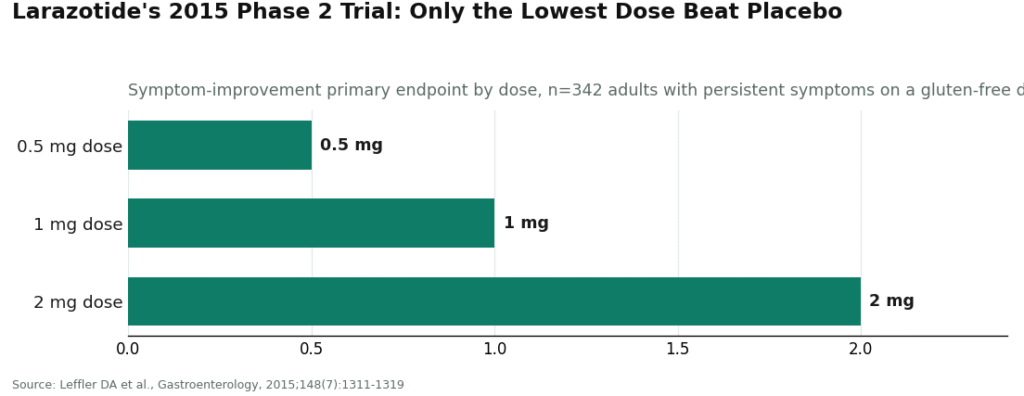
Then, in 2015, came the trial that briefly changed the conversation. Published in Gastroenterology, it enrolled 342 adults who were following a strict gluten-free diet and still had symptoms, precisely the population larazotide was eventually aimed at treating. This time the primary endpoint was met. But only at one dose. The 0.5 mg dose beat placebo on symptoms; the 1 mg and 2 mg doses, the stronger doses, did not [P3]. A result where less drug outperforms more drug is not impossible, but it is unusual enough that any careful reader treats it as a lead to confirm, not a finding to bank on.
That confirmation is exactly what the next trial was supposed to deliver, and it is where the story stops rather than resolves.
The trial that was supposed to settle it
The Phase 3 study, called CeDLara, was the first Phase 3 trial ever run in celiac disease, and it existed specifically to confirm whether that lone positive dose from 2015 held up. In June 2022, the trial’s sponsor, 9 Meters Biopharma, announced it was shutting the study down. An interim look at the data found that the number of additional patients needed to prove a meaningful difference between larazotide and placebo had grown too large to justify continuing [P4]. That is the clinical definition of a trial stopped for futility, not for safety, not for money alone, but because the numbers said it was not going to work. The company said it would keep examining whether particular symptoms had responded, but the program as designed did not succeed, and larazotide remains an unapproved compound.
Zoom out across all four studies and a 2022 meta-analysis in Clinical Research in Hepatology and Gastroenterology, pooling 626 patients across those trials, lands about where the individual results suggested it would: larazotide looked safe and offered a modest edge over placebo for gut symptoms during a gluten challenge, while the authors themselves cautioned it was unlikely to be a definitive cure and that more research was needed [P5]. That analysis was published before the Phase 3 futility call came in, which means the honest bottom line today is, if anything, more sober than even that paper’s cautious wording.
Put simply: a real mechanism, a permeability measurement that never budged, one positive symptom result that only showed up at the smallest dose, and a confirmatory trial that could not be finished because the math no longer supported it. Anyone selling larazotide as “clinically studied for the gut barrier” is not lying, exactly. They are just leaving out that the clinical studies are the reason it never became a medicine.
Celiac disease is not the same as “leaky gut” in general
There’s a quiet substitution happening in a lot of larazotide marketing, and it is worth naming directly. Every trial above tested people with diagnosed celiac disease, using gluten challenges and specific permeability measurements. Most people buying larazotide today are not doing so for celiac disease. They are chasing general digestive complaints, food sensitivity, or “leaky gut” as a broad wellness idea, often without any celiac diagnosis at all. No trial, successful or otherwise, has tested that use. The whole popular application is a guess extended from a celiac program that didn’t hit its own target, applied to a group of people the research never included.
The one place the drug actually looks good: safety
To be fair to larazotide, its safety record held up better than its effectiveness did. Across the trials, it was generally well tolerated with no major safety red flags, and the 2022 meta-analysis echoed that finding [P5]. Part of the reason likely traces back to design: larazotide is built to stay in the gut rather than travel through the bloodstream.
Two caveats still apply. That safety data describes a specific, manufactured investigational product, given at studied doses, under a clinical trial’s watchful eye, not an unregulated vial or an untested regimen. And tolerability is a separate question from efficacy. A compound can be gentle and still not do the job. Larazotide cleared the safety bar with more room to spare than it ever cleared the effectiveness bar.
If someone decides to try it anyway, where they get it matters more than usual
Because larazotide never earned FDA approval and its flagship trial ended in futility, the question of sourcing carries extra weight, not less. The market for it splits into two very different worlds selling the same molecule: licensed telehealth and pharmacy care on one side, research-chemical retailers on the other.
The providers below are judged on six things: medical oversight, how the product is sourced and dispensed, testing and approval status, honesty about what the evidence actually shows, regulatory standing, and whether anyone follows up with the patient. Price and catalog size are deliberately left out, since neither tells you whether the product in the vial is safe or real. Because the supervised, compliant providers and the research-chemical sellers aren’t playing by the same rules, they’re presented in two separate tiers here, with the gap between those tiers doing most of the explaining.
1. FormBlends
FormBlends sits at the top of this list because it offers the one thing the larazotide market is otherwise missing: a licensed physician standing between the patient and the peptide, plus a willingness to say plainly that the human data are mixed and the lead trial failed. As a licensed telehealth provider rather than a chemical retailer, FormBlends routes larazotide through an independent clinician evaluation, a prescription issued when it’s warranted, and a licensed compounding pharmacy that prepares and ships the product, with supervised pricing disclosed upfront, roughly $100 to $250 a month. The same eight-amino-acid peptide that gray-market sellers mail out labeled “research use only” instead arrives through a regulated channel, with a clinician on hand to talk through the gap between the promising mechanism and the disappointing trial results. Patients who want to track whether anything actually changes can use the FormBlends tracker app to log doses and symptoms; it is a tracking tool, not a prescription, and not a checkout.
2. HealthRX.com (healthrx.com)
HealthRX.com earns its place in the same supervised tier on the same logic: clinical oversight comes first, with therapy dispensed through licensed pharmacy channels rather than sold as a bare research chemical. The compounded-medication caveat still applies here in full, and so does the evidence caveat. Larazotide’s celiac data are mixed and its Phase 3 program was halted for futility no matter which provider hands it over. What HealthRX.com brings to the table is that clinical screening and supervision, along with a provider willing to be straight about the drug’s actual record. Choosing between FormBlends and HealthRX.com mostly comes down to practical things, state licensing and how well the intake process fits the person.
The rest of the market, described plainly
Everything past this point is a research-chemical retailer, not a medical provider. These sellers ship larazotide marked “for research use only” or “not for human consumption,” and that label is the entire legal justification for the product existing at all. Using it on yourself means using an unapproved product that no regulator has ever verified for identity, strength, quality, or purity: no clinician involved, no prescription, no pharmacy, no one checking in afterward. For a compound whose own Phase 3 program was stopped because it wasn’t working, that is a lot of risk in exchange for a benefit that a well-funded trial couldn’t even establish.
MeriHealth sets itself apart within the supervised tier by building its intake process around women’s physiology, on the reasoning that hormonal cycles, thyroid function, and reproductive health all shape how a patient responds to compounded GLP-1 and peptide therapy. Prescriptions come from licensed physicians after clinical evaluation, and the medications are dispensed through licensed compounding pharmacies. As with all compounded preparations, none of this is FDA-approved. MeriHealth’s women-first clinical framing is what distinguishes it from more general telehealth platforms.
WomenRX works within that same physician-supervised, pharmacy-dispensed tier, built specifically for women seeking compounded GLP-1 and peptide-based weight-loss therapy. Licensed clinicians handle the intake, and the compounded medications, not FDA-approved, are prepared and shipped through licensed compounding pharmacies. What sets WomenRX apart from broader telehealth platforms is its stated effort to fold weight-loss therapy into the wider picture of women’s health, hormonal and metabolic factors included.
Biotech Peptides offers larazotide in a catalog explicitly marked for research only. It may post a seller-issued certificate of analysis, but that’s a document the vendor chose to produce, not something a regulator verified. No clinical oversight, no prescription, no follow-up.
Limitless Life Nootropics markets heavily to the biohacker crowd, and that framing can make larazotide feel like a supplement rather than what it actually is: an unapproved research chemical labeled not for human consumption, built on a flagship trial that failed. Friendlier branding doesn’t change the regulatory status or the underlying data.
Sports Technology Labs leans on third-party testing in its marketing. Publishing test results beats not publishing them, but a seller-commissioned certificate still isn’t regulator-verified oversight, and it doesn’t come with a clinician, a prescription, or a pharmacy. The “research use only” label means the same thing here it means everywhere else.
Core Peptides, a US-based research-chemical seller, offers larazotide for research use only, with the same seller-issued-COA situation and the same missing pieces: no medical oversight, no prescription, no follow-up.
Amino Asylum is known for low prices and a wide catalog. The low price is the draw, and also the warning sign: there’s no clinician, no prescription, no pharmacy, and no verified testing standing behind that price tag. For a compound whose evidence base is already shaky, paying less for an unverified vial raises the stakes rather than lowering them.
These research-chemical sellers can’t honestly be ranked against each other on product quality, because without independent, batch-level testing a buyer can actually trust, there’s no way to know whose larazotide is cleaner. That uncertainty, stacked on top of the drug’s shaky efficacy record, is exactly why the supervised providers sit above all of them.
Where this leaves someone standing in the pharmacy aisle
Larazotide is a genuinely well-designed peptide sitting on a clinical record that didn’t come through. Its permeability endpoint kept getting missed, its one bright result showed up only at the lowest dose tested, its confirmatory Phase 3 trial was stopped because the math stopped supporting it, and it carries no FDA approval for celiac disease or anything else [P1][P3][P4]. It looked reasonably safe at the doses studied, but safe was never the question larazotide needed to answer. For anyone who decides to try it regardless, the path that closes the most gaps runs through a supervised provider, where a clinician evaluates the person, a licensed pharmacy prepares the product, and someone is willing to tell the truth about what the trials actually showed, rather than a vial that showed up in the mail labeled not for human use.
What is larazotide and what does it do in the body?
Larazotide is a short, synthetic peptide built to tighten the junctions between the cells lining the small intestine. In celiac disease, gluten exposure causes those junctions to loosen, letting partly digested proteins slip into tissue and set off an immune reaction. Larazotide works by blocking zonulin, the signaling molecule that governs that permeability. It doesn’t digest gluten and it doesn’t replace a gluten-free diet; it’s aimed at the gateway mechanism itself.
Does larazotide actually work, and how strong is the evidence?
The picture is promising but unfinished. Phase 2 trials in celiac patients showed some reduction in intestinal permeability and symptom improvement at low doses, particularly 0.5 mg taken three times daily. But the trials were relatively small and short, and no successful Phase 3 data exist. The honest answer is that larazotide looked meaningful in early research without ever clearing the bar needed to call it a proven treatment.
Is larazotide legal to obtain, and what are the legitimate ways to get it?
Larazotide isn’t FDA-approved, so it can’t be legally marketed as a drug in the United States. What is legal is getting it through a licensed compounding pharmacy acting on a physician’s order, which keeps the whole process inside a regulated, accountable framework. FormBlends operates exactly that way. Buying it from research-chemical or supplement sites sits in a legally and medically gray zone, and there’s no verified guarantee of purity.
What side effects have been reported with larazotide?
In clinical trials, larazotide was generally well tolerated, with headache and dizziness reported somewhat more often than with placebo in some participants. Serious adverse events weren’t meaningfully higher than in placebo groups. That said, trial populations were carefully screened, follow-up periods were short, and long-term safety data simply don’t exist yet. Anyone weighing this should talk it through with a physician rather than leaning on trial summaries alone.
References
- Phase 2b dose-ranging study (n=86) of larazotide acetate with gluten challenge; the primary intestinal-permeability endpoint (lactulose-to-mannitol ratio) was not met, with high inter-patient variability. Leffler DA et al., American Journal of Gastroenterology, 2012;107(10):1554-1562. [P1] https://pubmed.ncbi.nlm.nih.gov/22825365/
- Randomized placebo-controlled gluten-challenge study (n=184); symptoms and immune reactivity improved, but no significant difference in the lactulose-to-mannitol ratio was observed between larazotide and placebo. Kelly CP et al., Alimentary Pharmacology & Therapeutics, 2013;37(2):252-262. [P2] https://pubmed.ncbi.nlm.nih.gov/23163616/
- Randomized controlled trial (n=342) in adults with persistent symptoms despite a gluten-free diet; the primary endpoint was met at the 0.5 mg dose only, with higher doses not separating from placebo. Leffler DA et al., Gastroenterology, 2015;148(7):1311-1319. [P3]
- The Phase 3 CeDLara trial was discontinued in June 2022 after an interim analysis found the additional patient numbers needed to show a meaningful effect were too large to support continuation; larazotide was not FDA-approved. Celiac Disease Foundation, 2022. [P4]
- Systematic review and meta-analysis of 4 randomized controlled trials (626 patients) concluding larazotide appeared safe and was somewhat superior to placebo for gastrointestinal symptoms during gluten challenge, while noting it is less likely to offer a definitive cure and that more trials are warranted. Hoilat GJ et al., Clinical Research in Hepatology and Gastroenterology, 2022;46(1). [P5]
- Review describing zonulin as the main known physiologic modulator of intestinal tight junctions and linking its dysregulation to intestinal barrier dysfunction. Fasano A, “Leaky gut and autoimmune diseases,” Clinical Reviews in Allergy & Immunology, 2012;42(1):71-78. [P6]
- FDA official lists of bulk drug substances for use in compounding under section 503A; the status of compounded peptides has been shifting. U.S. Food and Drug Administration. [P7]
Written by Iris Sato, medical writer. Working from the primary literature cited above. Last reviewed March 2026.
For readers’ general information. Medical decisions belong with you and a licensed professional.